If you're selling food products in the United States, understanding FDA nutrition facts label requirements is essential. This comprehensive guide covers everything you need to know about creating compliant nutrition labels.
What is the FDA Nutrition Facts Label?
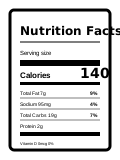
The Nutrition Facts label is a standardized panel required on most packaged foods sold in the United States. It provides consumers with essential information about the nutritional content of food products.
The label format is regulated by the FDA under 21 CFR 101.9 (Code of Federal Regulations, Title 21, Section 101.9).
The 2016 FDA Label Update
In May 2016, the FDA announced significant updates to the Nutrition Facts label - the first major revision since the label was introduced in 1994. Key changes include:
Visual Changes
- Larger, bolder "Calories" display: Calories are now more prominent
- Updated serving sizes: Reflect how people actually eat today
- New "Added Sugars" line: Distinguishes between natural and added sugars
- Updated Daily Values: Based on newer scientific evidence
New Required Nutrients
The 2016 update changed which nutrients must appear on the label:
| Now Required | No Longer Required |
|---|---|
| Vitamin D | Vitamin A |
| Potassium | Vitamin C |
| Added Sugars | - |
Note: Vitamin A and C can still be listed voluntarily
Mandatory Nutrients on FDA Labels
Every Nutrition Facts label must include these nutrients:
Required Information
- Serving Size - In common household measures and metric units
- Servings Per Container - Number of servings in the package
- Calories - Total calories per serving
- Total Fat - In grams
- Saturated Fat - In grams
- Trans Fat - In grams
- Cholesterol - In milligrams
- Sodium - In milligrams
- Total Carbohydrate - In grams
- Dietary Fiber - In grams
- Total Sugars - In grams
- Added Sugars - In grams (new in 2016)
- Protein - In grams
- Vitamin D - In mcg and %DV
- Calcium - In mg and %DV
- Iron - In mg and %DV
- Potassium - In mg and %DV
Daily Value Percentages
Most nutrients must show a Percent Daily Value (%DV) based on a 2,000 calorie diet. The 2016 update revised many Daily Values:
| Nutrient | Daily Value |
|---|---|
| Total Fat | 78g |
| Saturated Fat | 20g |
| Cholesterol | 300mg |
| Sodium | 2,300mg |
| Total Carbohydrate | 275g |
| Dietary Fiber | 28g |
| Added Sugars | 50g |
| Vitamin D | 20mcg |
| Calcium | 1,300mg |
| Iron | 18mg |
| Potassium | 4,700mg |
FDA Rounding Rules
The FDA specifies exact rounding rules for displaying nutrition values. These rules ensure consistency across all food labels.
Calorie Rounding
| Calorie Range | Rounding Rule |
|---|---|
| Less than 5 | Express as 0 |
| 5 to 50 | Round to nearest 5 |
| Greater than 50 | Round to nearest 10 |
Fat Rounding (grams)
| Amount | Rounding Rule |
|---|---|
| Less than 0.5g | Express as 0 |
| 0.5g to 5g | Round to nearest 0.5g |
| Greater than 5g | Round to nearest 1g |
Sodium and Cholesterol (mg)
| Amount | Rounding Rule |
|---|---|
| Less than 5mg | Express as 0 |
| 5mg to 140mg | Round to nearest 5mg |
| Greater than 140mg | Round to nearest 10mg |
Percent Daily Value
| %DV Range | Rounding Rule |
|---|---|
| Less than 2% | Express as 0% |
| 2% to 10% | Round to nearest 2% |
| 10% to 50% | Round to nearest 5% |
| Greater than 50% | Round to nearest 10% |
Serving Size Requirements
Serving sizes must be based on Reference Amounts Customarily Consumed (RACCs) established by the FDA. Key points:
- Express in common household measures (cups, tablespoons, pieces)
- Include metric equivalent in parentheses
- Reflect amounts people typically eat, not recommended portions
- Single-serving containers must list the entire package as one serving
Examples of Proper Serving Sizes
- Cereal: 1 cup (40g)
- Cookies: 3 cookies (34g)
- Juice: 8 fl oz (240mL)
- Chips: About 15 chips (28g)
Who Needs a Nutrition Facts Label?
Required For:
- Most packaged foods sold in the US
- Foods making nutrient content claims
- Foods making health claims
- Foods with added vitamins, minerals, or protein
Exempt Products:
- Fresh produce (fruits and vegetables)
- Single-ingredient raw meat, poultry, and seafood
- Foods produced by small businesses (under certain conditions)
- Foods sold in restaurants and food service establishments
- Medical foods
- Infant formula (has separate requirements)
Common Compliance Mistakes
Avoid these frequent errors when creating nutrition labels:
- Incorrect rounding - Not following FDA rounding rules
- Wrong serving sizes - Not using RACC-based portions
- Missing nutrients - Omitting required nutrients like Added Sugars
- Outdated Daily Values - Using pre-2016 reference values
- Improper formatting - Not following FDA format specifications
- Inaccurate data - Using estimates instead of lab analysis
How to Get Accurate Nutrition Data
For commercial products, accurate nutrition data is essential. Options include:
Laboratory Analysis (Recommended)
- Most accurate method
- Required for many commercial products
- Provides legally defensible data
- Cost: $100-500+ per product
Database Calculation
- Uses USDA FoodData Central or similar databases
- Acceptable for simple products
- Less accurate for complex recipes
- Cost: Free to moderate
Nutrition Analysis Software
- Calculates values from ingredient databases
- Good for recipe-based products
- Accuracy depends on database quality
- Cost: Varies by software
Using NutritionLabel.ai
Once you have accurate nutrition data, NutritionLabel.ai helps you create properly formatted FDA labels:
- Enter your nutrition values - Input data from lab analysis or calculations
- Preview in real-time - See your FDA-compliant label instantly
- Download - Export as PNG or PDF for your packaging
Our tool automatically applies FDA rounding rules and formats your label according to 21 CFR 101.9 specifications.
Conclusion
Creating FDA-compliant nutrition labels requires attention to detail and understanding of current regulations. Key takeaways:
- Use the 2016 FDA format with updated Daily Values
- Include all mandatory nutrients, especially Added Sugars
- Follow FDA rounding rules precisely
- Base serving sizes on RACCs
- Get accurate nutrition data through lab analysis when possible
For more information, consult the FDA Food Labeling Guide or work with a food regulatory consultant.
Ready to create your nutrition label? Try our free FDA label generator - no signup required.